For years, growth in software companies followed a fairly predictable pattern.
More customers meant more product demands, more product demands meant more engineering work, and more engineering work eventually meant a larger team. Headcount became one of the most visible indicators of a company's ability to build and scale.
That relationship is becoming less straightforward.
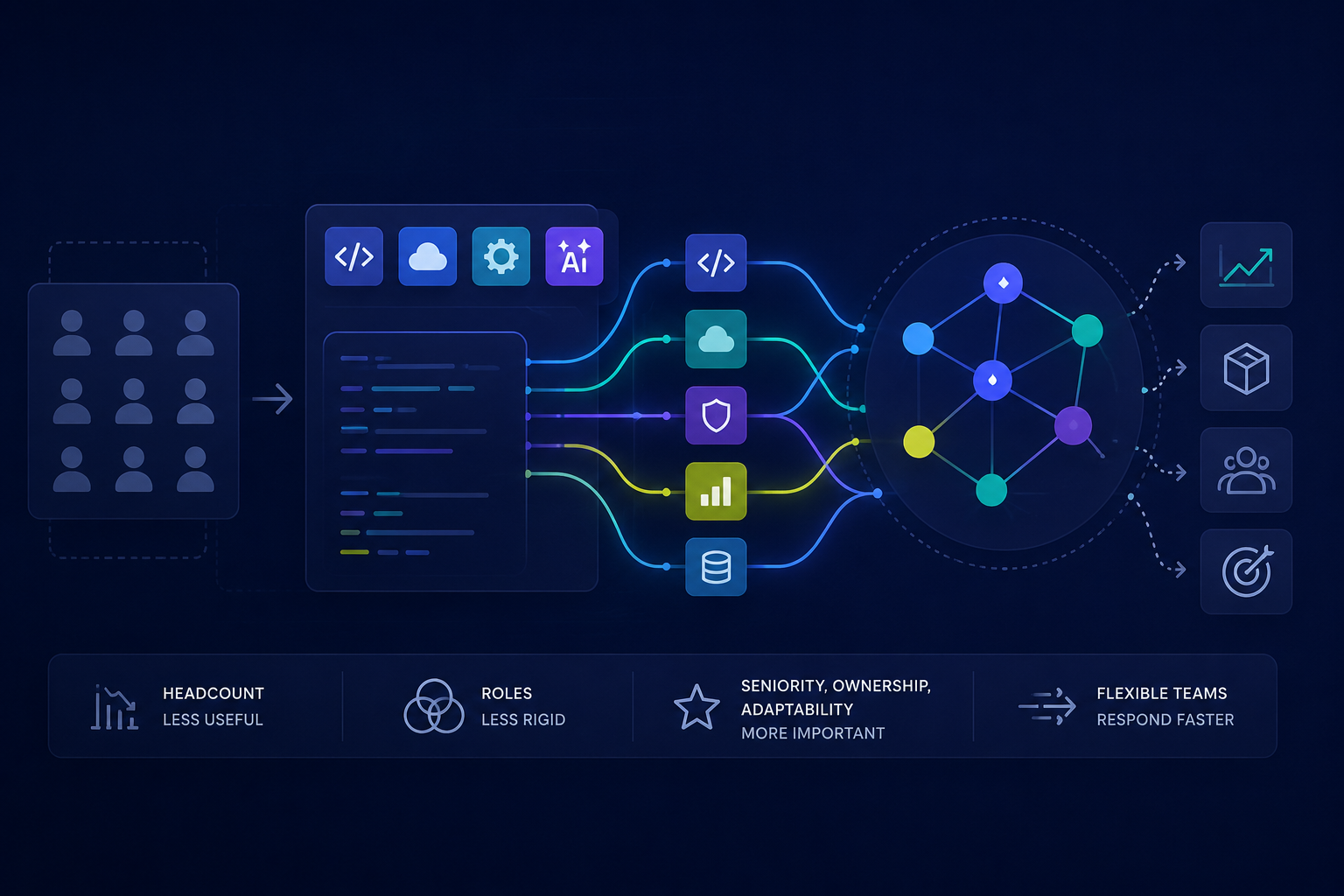
AI-assisted development, increasingly sophisticated cloud platforms, better developer tooling, automation, and mature infrastructure services are allowing engineers to accomplish more without expanding teams at the same rate. It's tempting to interpret this as the beginning of much smaller engineering organizations. In reality, something more interesting is happening: the composition of those teams is changing.
The question for engineering leaders is increasingly shifting from how many developers they need to what kind of engineers they need around the table.
More leverage changes what makes an engineer valuable
A significant portion of software development has historically been constrained by implementation time. Engineers had to write boilerplate, build common functionality from scratch, configure infrastructure manually, search through documentation, and spend hours on tasks that modern tools can now accelerate considerably.
AI has made that shift more visible, but it didn't start with AI. Cloud infrastructure removed much of the work associated with maintaining physical systems. Managed services simplified databases, authentication, observability, and deployment. CI/CD automated repetitive delivery processes. Open-source ecosystems made sophisticated functionality available through established frameworks and libraries.
Generative AI is another major step in the same direction. Engineers can now generate code, explore unfamiliar codebases, write tests, troubleshoot problems, and produce documentation considerably faster than before.
When implementation becomes easier, however, the value of engineering doesn't disappear. It moves.
Knowing what should be built, understanding how a change affects the rest of a system, deciding when an AI-generated solution is appropriate, evaluating architectural tradeoffs, and recognizing technical risk become proportionally more important. The engineer who can make those decisions well becomes more valuable precisely because the tools around them have become more powerful.
The boundaries between engineering roles are becoming less rigid
Modern engineering teams are also becoming harder to describe through narrow job definitions. A backend engineer may need to understand cloud infrastructure and deployment. A frontend engineer may work with AI APIs, analytics, and experimentation. A platform engineer increasingly needs to understand developer experience as well as infrastructure. Senior engineers often move across several of these areas during the same project.
This doesn't mean specialization is disappearing. Deep expertise remains essential in areas such as security, data engineering, machine learning, infrastructure, and complex architecture. What is changing is the expectation that expertise exists in isolation.
As tools remove more of the mechanical work around implementation, engineers have greater scope to contribute beyond their traditional boundaries. The strongest teams benefit from people who can go deep when necessary while still understanding the broader system, the product they are building, and the business problem behind it.
That has consequences for hiring. A checklist of technologies can tell you whether someone has worked with a particular framework. It says much less about whether that person can enter an unfamiliar environment, understand it quickly, make sensible decisions, and take ownership of an outcome.
Those qualities are becoming increasingly difficult to separate from technical ability.
Smaller isn't necessarily the goal
The productivity gains created by AI and automation have led to an understandable prediction: if each developer can accomplish more, companies will simply need fewer developers.
That may happen in some organizations and for some types of work. But increased productivity has rarely resulted in companies deciding that they have built enough software.
When the cost of creating something falls, businesses usually find more things worth creating. Faster engineering can make previously marginal projects viable, allow teams to experiment more frequently, accelerate modernization efforts, or turn ideas that once sat in a backlog into realistic initiatives.
Expectations rise alongside productivity.
A team that can deliver twice as quickly isn't necessarily asked to do the same work with half as many people. It may instead be asked to deliver more products, test more ideas, integrate more systems, automate more processes, and respond to customers more quickly.
The future engineering organization may therefore be leaner in some areas and larger in others. What matters is that headcount becomes a less useful measure of capability. The better question is how much effective engineering capacity an organization can deploy against its priorities.
Seniority becomes a multiplier
This shift also changes the economics of experience.
A senior engineer has always brought more than coding speed to a team. Experience helps with architecture, prioritization, debugging, mentoring, risk assessment, and understanding the consequences of decisions that initially appear small. Modern development tools amplify those capabilities.
Give a powerful AI coding tool to someone who understands the architecture, recognizes security implications, knows when generated code is unnecessarily complex, and can evaluate whether a proposed solution will scale, and the tool becomes genuine leverage. The same tool without sufficient judgment can simply produce questionable decisions more quickly.
This is one reason engineering teams may become more senior rather than simply smaller. As routine implementation becomes easier to automate, a greater proportion of human contribution can move toward decisions that require context, accountability, and experience.
The ability to take ownership also becomes more important. Companies gain little from faster implementation if every decision still requires multiple layers of supervision. Engineers who can understand a problem, collaborate with the relevant stakeholders, choose an appropriate solution, and carry it through to production allow the entire organization to move faster.
Flexibility may matter more than permanent size
There is another consequence that receives less attention. If engineering needs are changing more quickly, companies may find it increasingly difficult to predict the exact team they will need twelve months from now.
A business might need data engineers for a migration, AI expertise for a new product initiative, cloud architects during a modernization project, or additional backend capacity around a major release. Six months later, the bottleneck may be somewhere entirely different.
Building every possible capability permanently into the organization is expensive and often unnecessary. Waiting months to hire whenever a new requirement emerges is equally problematic.
The ability to adjust engineering capacity quickly therefore becomes part of the operating model itself.
This is where the distinction between simply increasing headcount and building a flexible engineering organization becomes important. Companies need a strong internal core, but they also need ways to bring in experienced people when priorities change without creating months of hiring friction or another disconnected layer around the existing team.
At DevRank, this is increasingly how we see clients approaching engineering capacity. The objective is rarely to make a team bigger for its own sake. It is to add the right expertise when the business needs it, integrate that expertise into the existing team, and keep execution moving while priorities evolve.
The engineering team is becoming a different kind of organization
The most important change may ultimately be cultural rather than technological.
Engineering organizations built around clearly separated roles, predictable requirements, and long implementation cycles made sense when software development moved more slowly. Today's environment rewards teams that can absorb new tools, move between problems, make decisions with incomplete information, and continuously adjust how they work.
AI will accelerate that transition, but it won't define it on its own. The broader shift is from engineering organizations designed primarily around producing code to organizations designed around solving technical problems.
That requires different hiring decisions, different expectations of seniority, and a different understanding of what engineering capacity actually means.
The teams of the future may sometimes be smaller. They may sometimes be larger. They will almost certainly use more AI and automation than teams do today.
But size is unlikely to be what distinguishes the best ones.
The strongest engineering teams will be the ones built for leverage, ownership, and change.